

Task Teacher Guide
Be sure to read the teacher guide prior to running the task. When you’re ready to run the task, use the tabs at the top of the page to navigate through the lesson.
[accordion openall="false" clicktoclose="true" state="closed" autoclose="false" openfirst="true" clicktoclose="true"]
[accordion-item title=”In This Task…”]
Students will solve an equation related to the Whirlpool Aero Car. They will consolidate the purpose for using a variable to represent a quantity, and solve for that variable using an appropriate model.
[/accordion-item]
[accordion-item title=”Intentionality…”]
Students will explore the use of a variable to represent a changing/unknown quantity. They will be presented with an expression used to track the total number of passengers who ride the aerocar in a single day.
Some of the big ideas that will likely emerge in this task include:
- Multiplication and division are related.
- There are two types of division.
- Quotative (or measured) division reveals the numbers of parts when the rate is known.
- The dividend from any division sentence can be decomposed into smaller parts to allow for friendlier division by the divisor. This strategy is known as partial quotients (i.e.: 85 ÷ 5 = 45 ÷ 5 + 40 ÷ 5 = 9 + 8 = 17).
- Partial products, made possible by the distributive property, allows one or both of the factors to be decomposed in order to simplify a multiplication sentence.
- Variables are used to represent changing or unknown quantities.
- When solving an equation where the coefficient of the unknown variable is not equal to 1, division is required to determine the value of the unknown variable and the context of the problem determines which type of division is required (i.e.: the Aero Car context requires quotative division).
[/accordion-item]
[/accordion]
Spark
[accordion openall="false" clicktoclose="true" state="closed" autoclose="false" openfirst="false" clicktoclose="true"]
[accordion-item title=”What Do You Notice? What Do You Wonder?”]
Show students the following video:
Give students 60 seconds (or more) to do a rapid write on a piece of paper.
Replaying the video and/or leaving a screenshot from the video up can be helpful here.
Then, ask students to share with their neighbours for another 60 seconds.
Finally, allow students to share with the entire group. Be sure to write down these noticings and wonderings on the blackboard/whiteboard, chart paper, or some other means to ensure students know that their voice is acknowledged and appreciated.
Some of the noticing and wondering that may come up include:
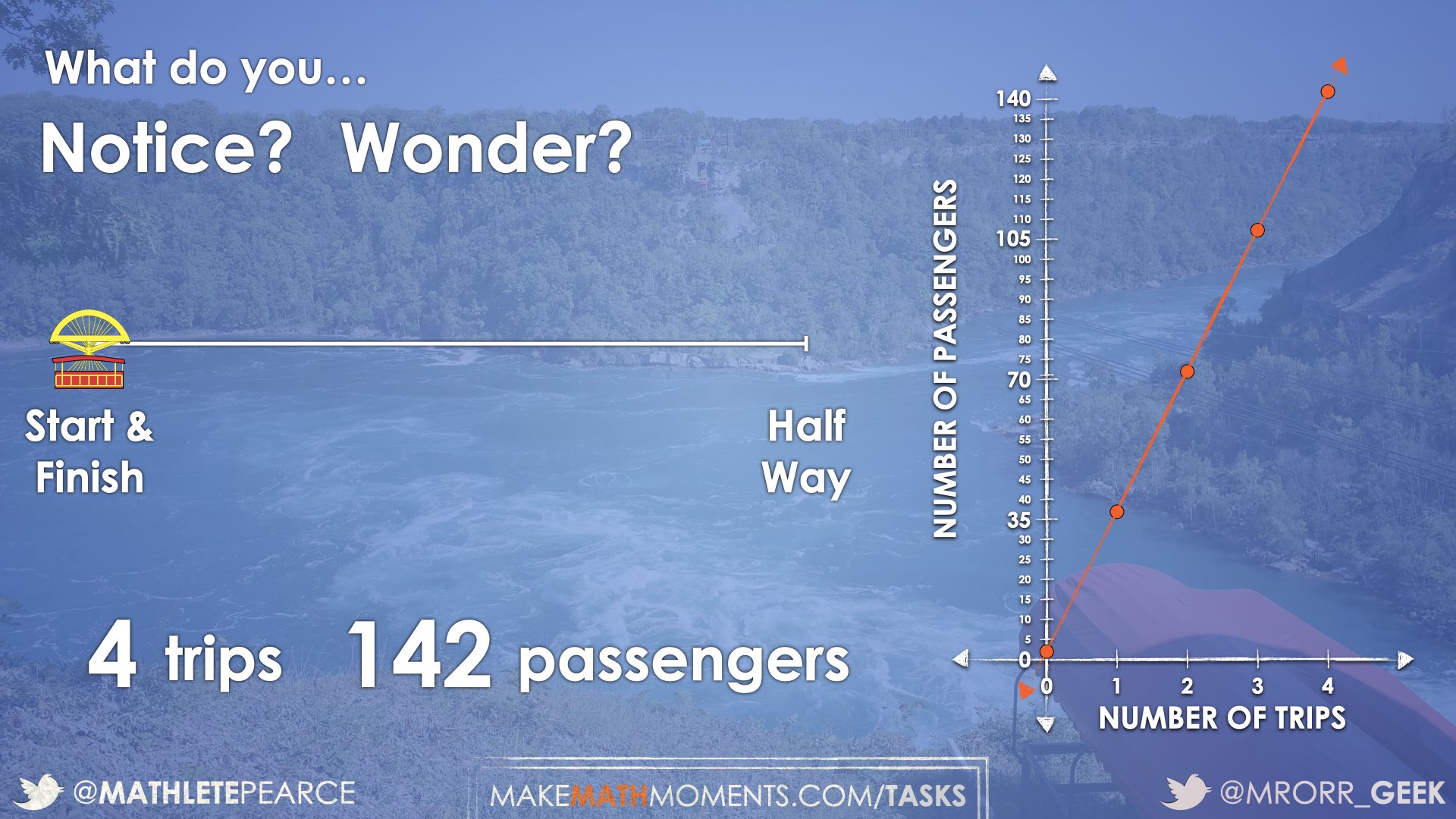
- I notice a graph
- It notice cars and passengers
- I notice that is goes up every time
- I notice the first point was just past 35
- I notice it is a straight diagonal line
- I wonder if it has something to do with the aerocar
- I wonder what they are keeping track of
- I wonder if it will continue in a straight line
- I wonder when it will stop
[/accordion-item]
[accordion-item title=”Prediction: Prompt”]
Share the following equation used to create this graph and prompt students with:
Student prompt:
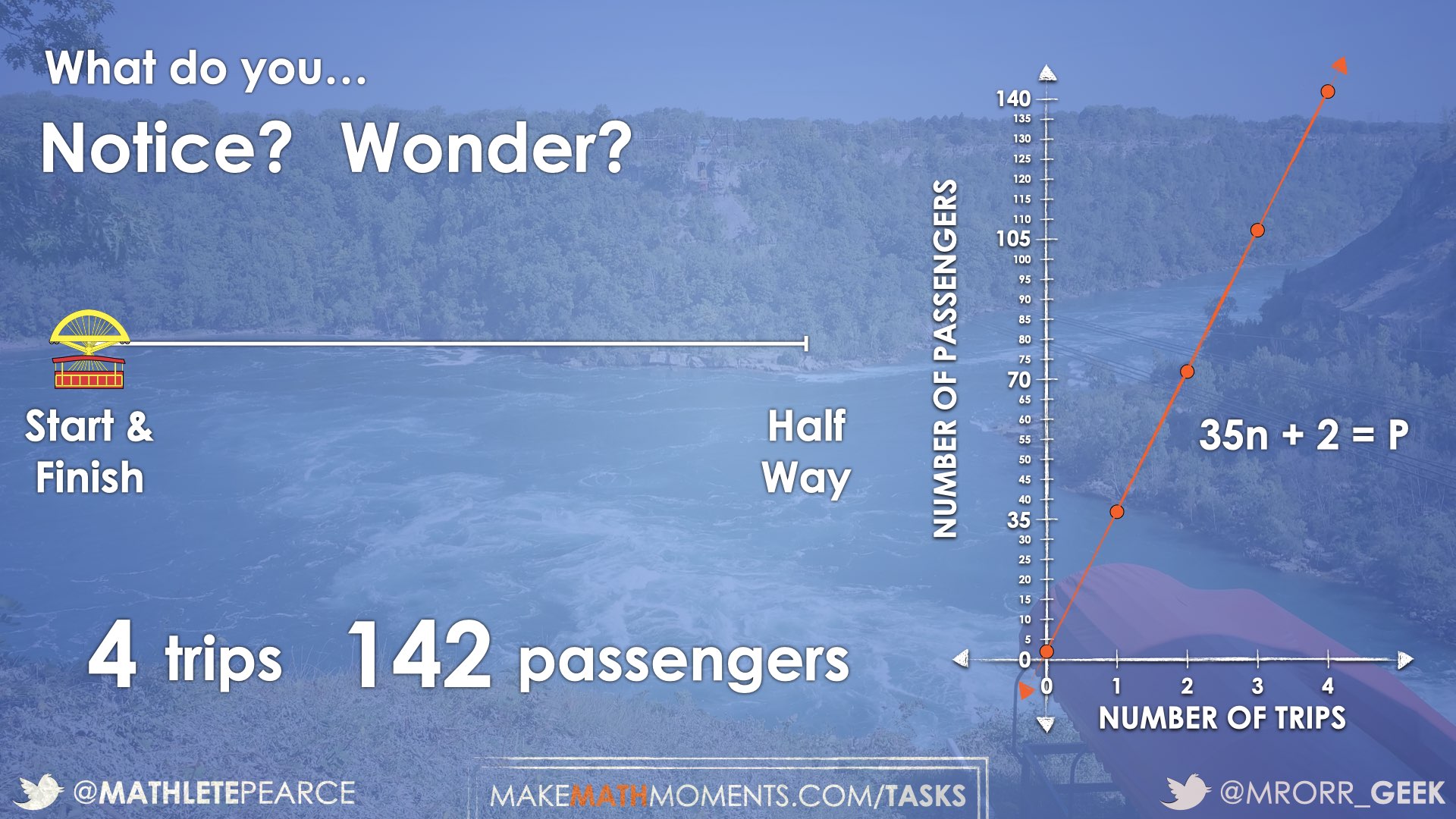
The equation that corresponds to the graph is as follows:
35n + 2 = P
What do you think this equation represents?
Make a prediction.
[/accordion-item]
[accordion-item title=”While Students Are Predicting”]
Listen and observe as students work to make their predictions. Are students making connections to their prior knowledge? For example, they already know that each trip on the Whirlpool Aero Car carries 35 passengers.
How are students responding to the variable. Are they demonstrating an understanding of why variables are used in an expression?
They may be curious about the plus 2. Consider what they think this could mean, and how it would impact the graph that they viewed in the video.
Have students share their predictions.
[/accordion-item]
[accordion-item title=”Prediction: Reveal”]
Explain that this expression is used to determine the total number of passengers in a single day, assuming that every trip reaches the cars maximum capacity.
35 passengers/trip x number of tourist trips + 2
Before adding the unit for the constant, 2, have students update and share their predictions for its meaning.
Explain that every day, 2 employees travel to the other side with the passengers. Those two employees are included (only once) in the total number of unique passengers per day.
35 passengers/trip x number of tourist trips + 2 employees
[/accordion-item]
[/accordion]
Sense Making
[accordion openall="false" clicktoclose="true" state="closed" autoclose="false" openfirst="false" clicktoclose="true"]
[accordion-item title=”Crafting A Productive Struggle:”]
Show students the following video:
Student prompt:
Consider the following equation:
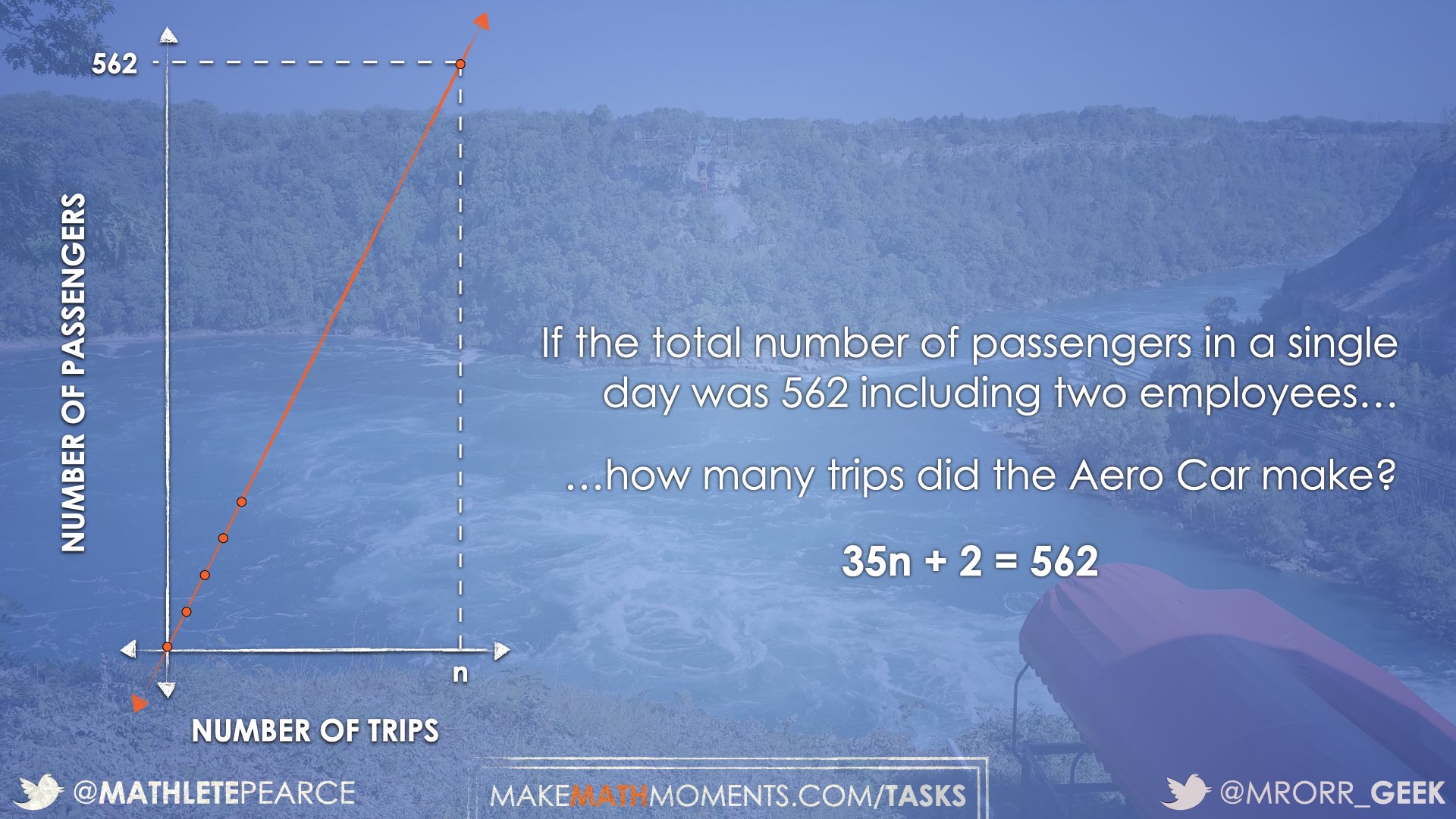
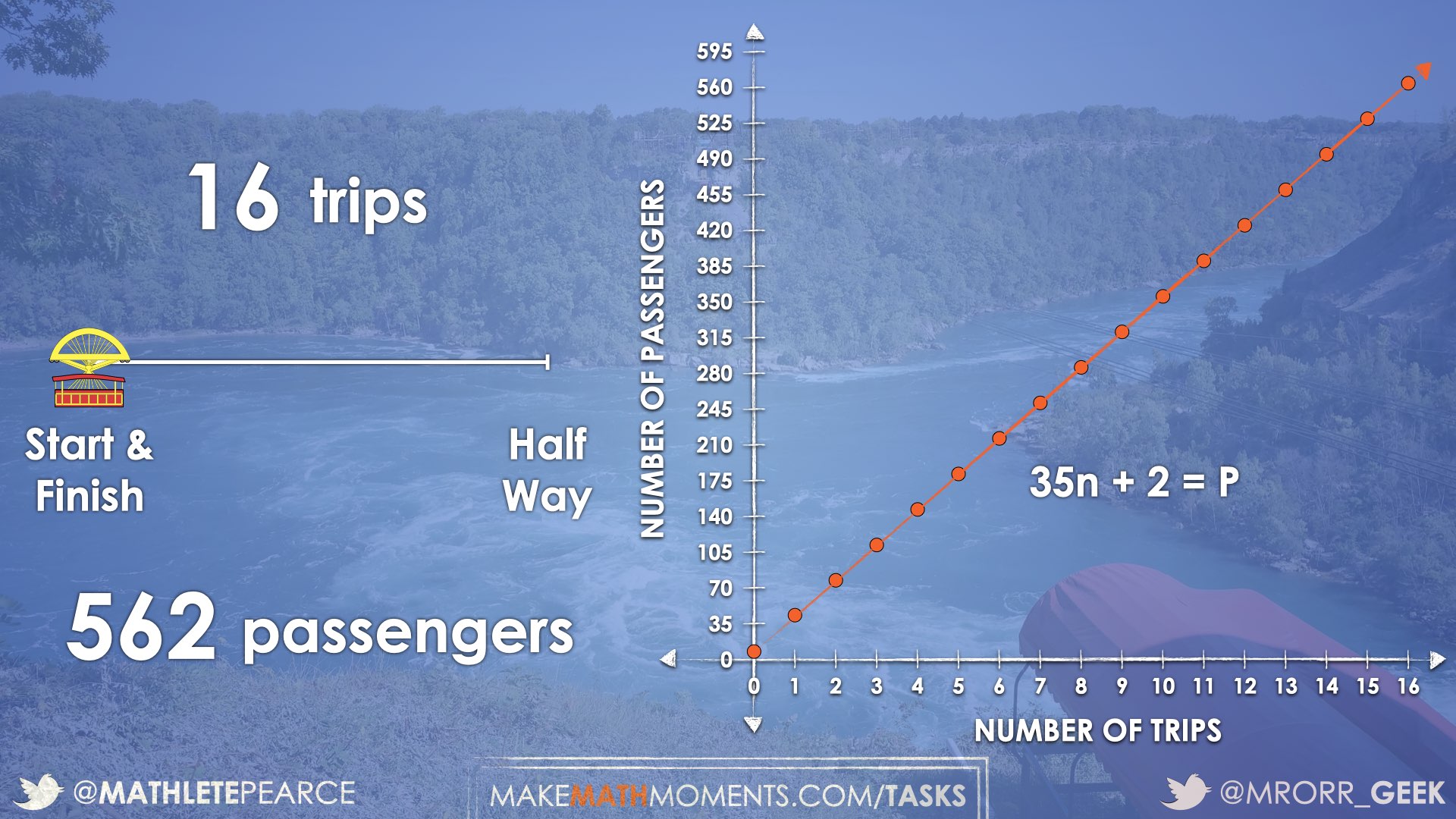
35 x n + 2 = 562
If the total number of passengers in a single day was 562 including two employees, how many trips did the Aero Car make?
Consider leaving this image up for students as they begin to struggle through this problem.
[/accordion-item]
[/accordion]
During Moves
[accordion openall="false" clicktoclose="true" state="closed" autoclose="false" openfirst="false" clicktoclose="true"]
[accordion-item title=”While Students Are Productively Struggling:”]
Login/Join to access the entire Teacher Guide, downloadable slide decks and printable handouts for this lesson and all problem based units.
[/accordion-item]
[accordion-item title=”Student Approach #1: Partitioning a Bar Model “]
Login/Join to access the entire Teacher Guide, downloadable slide decks and printable handouts for this lesson and all problem based units.
[/accordion-item]
[accordion-item title=”Student Approach #2: Partial Products and Symbolic Notation”]
Login/Join to access the entire Teacher Guide, downloadable slide decks and printable handouts for this lesson and all problem based units.
[/accordion-item]
[accordion-item title=”Student Approach #3: Partial Products on a Number Line”]
Login/Join to access the entire Teacher Guide, downloadable slide decks and printable handouts for this lesson and all problem based units.
[/accordion-item]
[/accordion]
Next Moves
[accordion openall="false" clicktoclose="true" state="closed" autoclose="false" openfirst="false" clicktoclose="true"]
[accordion-item title=”Consolidation: Making Connections”]
Login/Join to access the entire Teacher Guide, downloadable slide decks and printable handouts for this lesson and all problem based units.
[/accordion-item]
[accordion-item title=”Reveal”]
After consolidating the lesson by using student work to make connections to the big ideas, strategies and models we had hoped to emerge, you can show this reveal video:
Alternatively, you can show this reveal image:
[/accordion-item]
[accordion-item title=”Reflect”]
Provide students an opportunity to reflect on their learning by offering this consolidation prompt to be completed independently.
Consolidation Prompt:
Login/Join to access the entire Teacher Guide, downloadable slide decks and printable handouts for this lesson and all problem based units.
Download Editable/Printable Handout
Become a member to access purposeful practice to display via your projector/TV, download the PDF to upload to your LMS and/or print for students to have a physical copy

[/accordion-item]
[/accordion]
Resources and Downloads
Lesson Tip Sheet

Download the lesson plan in PDF format so you can keep it handy and share with colleagues.
Videos & Images
 Download the videos, images, and related media files to your computer to avoid streaming.
Keynote Slides
 Download in Apple Keynote format to avoid streaming video and run the lesson smoothly.
PowerPoint Slides
 Download in Microsoft PowerPoint format to avoid streaming video and run the lesson smoothly.
Printable Handout
Download/edit the handout so you can keep it handy and share with colleagues.
Explore The Entire Unit of Study
This Make Math Moments Task was designed to spark curiosity for a multi-day unit of study with built in purposeful practice, and extensions to elicit and emerge mathematical models and strategies.
Click the links at the top of this task to head to the other related lessons created for this unit of study.
[accordionopenall="false" clicktoclose="true" state="closed" autoclose="false" openfirst="true" clicktoclose="true"]
[accordion-item title=”What Do You Notice? What Do You Wonder?”]
[/accordion-item]
[accordion-item title=”Spark Image”]
[/accordion-item]
[accordion-item title=”Prediction: Prompt”]
The equation that corresponds to the graph is as follows:
35n + 2 = P
What do you think this equation represents?
[/accordion-item]
[/accordion]
[accordion openall="false" clicktoclose="true" state="closed" autoclose="false" openfirst="true" clicktoclose="true"]
[accordion-item title=”Crafting A Productive Struggle: Video”]
[/accordion-item]
[accordion-item title=”Prompt”]
Consider the following equation:
35n + 2 = 562
If the total number of passengers in a single day was 562 including two employees, how many trips did the Aero Car make?
[/accordion-item]
[/accordion]
[accordion openall="false" clicktoclose="true" state="closed" autoclose="false" openfirst="true" clicktoclose="true"]
[accordion-item title=”Reveal: Video”]
[/accordion-item]
[accordion-item title=”Reveal: Image”]
[/accordion-item]
[/accordion]
[accordion openall="false" clicktoclose="true" state="closed" autoclose="false" openfirst="true" clicktoclose="true"]
[accordion-item title=”Consolidation Prompt:”]
Login/Join to access the entire Teacher Guide, downloadable slide decks and printable handouts for this lesson and all problem based units.
[/accordion-item]
[/accordion]
Download Editable/Printable Handout
Become a member to access purposeful practice to display via your projector/TV, download the PDF to upload to your LMS and/or print for students to have a physical copy