

Task Teacher Guide
Be sure to read the teacher guide prior to running the task. When you’re ready to run the task, use the tabs at the top of the page to navigate through the lesson.
[accordion openall="false" clicktoclose="true" state="closed" autoclose="false" openfirst="true" clicktoclose="true"]
[accordion-item title=”In This Task…”]
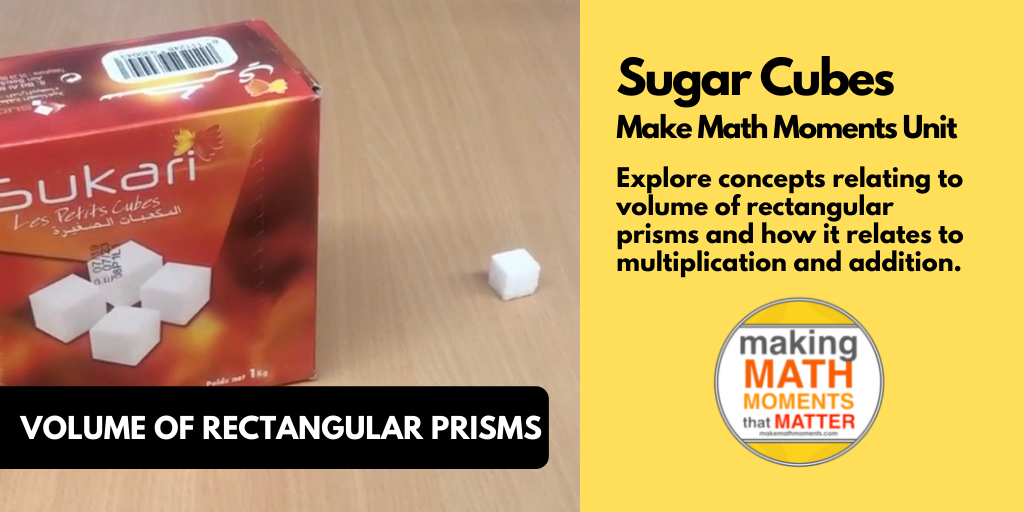
Students will determine which airtight container is best to hold the contents of a box of sugar cubes which has attracted ants.
[/accordion-item]
[accordion-item title=”Intentionality…”]
In this task, students compare the volume of three containers by using sugar cubes as the unit of measure. This task serves to reinforce the relationship between the volume of a rectangular prism and its edge lengths.
Some of the big ideas that will likely emerge in this task include:
- Volume can be measured by finding the total number of same-size units of volume required to fill the space without gaps or overlaps;
- The volume of a rectangular prism is related to the edge lengths;
- The volume of a rectangular prism can be determined by finding the area of the base and multiplying by the number of layers;
- The volume of a rectangular prism can be determined by multiplying length, width and height.
[/accordion-item]
[accordion-item title=”Lesson Walkthrough Video”]
Coming Soon
[/accordion-item]
[accordion-item title=”What You’ll Need…”]
A variety of tools for students to use to think through the problems, such as:
- Linking cubes or Omnifix cubes
- Isometric dot paper & colored pencils or markers
- Grid paper
- Whiteboards & markers
- Teaching remotely? NCTM’s Isometric Drawing Tool can be used to build and manipulate cube structures
[/accordion-item]
[/accordion]
Spark
[accordion openall="false" clicktoclose="true" state="closed" autoclose="false" openfirst="false" clicktoclose="true"]
[accordion-item title=”What Do You Notice? What Do You Wonder?”]
Show students the following video:
Then, ask students:
What do you notice?
What do you wonder?
![Sugar Cubes [Day 3] Sugar Cube Containers - 02 - Spark Image](https://learn.makemathmoments.com/wp-content/uploads/2021/05/Sugar-Cubes-Day-3-Sugar-Cube-Containers-02-Spark-Image.jpeg)
Have students do a Think-Pair-Share routine:
- Students have individual think time to jot down ideas on paper or whiteboard (minimum 1 minute). Students may benefit from watching the video a second time or having a still image from the video to refer to.
- Students share their observations and questions with a partner.
- Students share as a whole group, either their own noticings and wonderings, or a meaningful observation or question they heard from their partner during the share (while giving credit to their partner). All contributions are acknowledged and recorded on an anchor chart on the board.
Possible points that may come up include:
- I notice that the ants are attracted to the sugar.
- I wonder how long it would take for the ants to take all the sugar?
- I wonder which container will fit all the sugar cubes?
Spending time to acknowledge and address specific thoughts that students shared – whether a notice or a wonder – is crucial to building a culture in your classroom where students know that their voice is being valued and thus encourages them to continue sharing their thoughts and opinions later in this lesson and in future lessons.
[/accordion-item]
[accordion-item title=”Estimation: Prompt”]
Once student noticings and wonderings have been acknowledged and noted, the class can settle on a question to explore:
Which plastic container will store all the sugar cubes in order to avoid bugs like ants getting to them?
Make an estimate.
Students begin by predicting which of the three containers will fit all the sugar cubes before they are provided with all the information they need to answer the question, thus requiring them to consider how the dimensions of the rectangular prisms relate to each other.
Be sure not to skip over asking students to make an estimate using only their spatial reasoning skills as this is a very important step in the Curiosity Path. Providing students an opportunity to make an estimate and try to articulate their thinking with their peers provides a very low floor opportunity for them to not only better understand the context, but to also begin nudging them to think about what will be important to make their estimate more precise as we continue through the lesson.
Students should be given an opportunity to share their estimates at this point, but refrain from sharing their rationale just yet in order to give everyone a chance to develop their own thinking.
Have students turn to a partner and generate questions they could ask that would provide them with information they could use to answer the question. Ask students how they would use the information to answer the question.
Prompt students with:
What information would you need to answer the question?
How would you use that information?
[/accordion-item]
[accordion-item title=”Estimation: Partial Reveal & Update”]
Show students the reveal image from Day 1 and a photo of the 3 containers:
![Sugar Cubes [Day 3] Sugar Cube Containers - 03 - Spark Estimate IMage](https://learn.makemathmoments.com/wp-content/uploads/2021/05/Sugar-Cubes-Day-3-Sugar-Cube-Containers-03-Spark-Estimate-IMage.jpeg)
At this point, students may wish to update their estimates. Provide them with time to do so before revealing the next image.
A simple prompt might be:
You’ve seen how many cubes are in the sugar box, and the size of the plastic containers in comparison to the original box. Does this affect your estimate? Would you say your estimate is still reasonable, or will you revise it?
Provide students with time to revise their estimates.
[/accordion-item]
[accordion-item title=”While Students are Revising Their Estimates”]
Listen and observe as students revise their estimates.
How are students approaching the problem? What strategies and mathematical models are they leveraging? Are they:
- Comparing edge lengths to estimate the volume of each container?
- Using the layered structure in a rectangular prism to think about volume using multiplication?
This is an opportunity to make note of where students are developmentally. Prompt students to explain their thinking and how they plan to use their model/strategy to determine the total number of sugar cubes in the box.
[/accordion-item]
[/accordion]
Sense Making
[accordion openall=”false” clicktoclose=”true” state=”closed” autoclose=”false” openfirst=”false” clicktoclose=”true”]
[accordion-item title=”Crafting A Productive Struggle”]
Proceed to reveal the dimensions of the orange and red containers by showing the following image:
![Sugar Cubes [Day 3] Sugar Cube Containers - 04 - Sense Making - Struggle Prompt Image](https://learn.makemathmoments.com/wp-content/uploads/2021/05/Sugar-Cubes-Day-3-Sugar-Cube-Containers-04-Sense-Making-Struggle-Prompt-Image.jpeg)
To begin the sense making portion or the lesson, provide students with the following prompt:
The green box fits 5 cubes by 9 cubes by 3 layers.
The orange box fits 5 cubes by 9 cubes by 4 layers.
The red box fits 8 cubes by 12 cubes by 3 layers.
Which container will fit all the sugar cubes in the box?
Use a mathematical model of your choice to construct a viable argument that clearly shows how many sugar cubes are in the box.
Be sure to explicitly state that calculators are not to be used to determine the number of sugar cubes in the box. However, do consider making the following tools available to students without explicitly directing students to use them:
- Linking cubes or Omnifix cubes
- Isometric dot paper & colored pencils or markers
- Grid paper
- Whiteboards & markers
- NCTM’s Isometric Drawing Tool can be used to build and manipulate cube structures
Remind students to refrain from shouting out answers, and be sure to emphasize the importance of creating a viable argument – a model that can be used to convince others.
[/accordion-item]
[/accordion]
During Moves
[accordion openall="false" clicktoclose="true" state="closed" autoclose="false" openfirst="false" clicktoclose="true"]
[accordion-item title=”While Students Are Productively Struggling…”]
Login/Join to access the entire Teacher Guide, downloadable slide decks and printable handouts for this lesson and all problem based units.
[/accordion-item]
[accordion-item title=”Student Approach #1: Concrete manipulatives to directly model the different containers”]
Login/Join to access the entire Teacher Guide, downloadable slide decks and printable handouts for this lesson and all problem based units.
[/accordion-item]
[accordion-item title=”Student Approach #2: Additive and Multiplicative Strategies”]
Login/Join to access the entire Teacher Guide, downloadable slide decks and printable handouts for this lesson and all problem based units.
[/accordion-item]
[accordion-item title=”Student Approach #3: Flexible Use of Algorithm or Division Strategy”]
Login/Join to access the entire Teacher Guide, downloadable slide decks and printable handouts for this lesson and all problem based units.
[/accordion-item]
[/accordion]
Next Moves
[accordion openall="false" clicktoclose="true" state="closed" autoclose="false" openfirst="false" clicktoclose="true"]
[accordion-item title=”Consolidation: Making Connections”]
Login/Join to access the entire Teacher Guide, downloadable slide decks and printable handouts for this lesson and all problem based units.
[/accordion-item]
[accordion-item title=”Reveal”]
Consider sharing the following reveal video with your students:
The following image gives you a summary of the result when trying to store the box of sugar cubes in each container:
![Sugar Cubes [Day 3] Sugar Cube Containers - 05 - Next Moves - Reveal Image.001](https://learn.makemathmoments.com/wp-content/uploads/2021/05/Sugar-Cubes-Day-3-Sugar-Cube-Containers-05-Next-Moves-Reveal-Image.001.jpeg)
[/accordion-item]
[accordion-item title=”Reflect”]
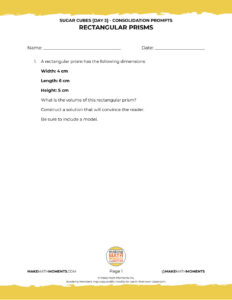
Provide students an opportunity to reflect on their learning by offering this consolidation prompt to be completed independently.
Consolidation Prompt #1:
Login/Join to access the entire Teacher Guide, downloadable slide decks and printable handouts for this lesson and all problem based units.
Consolidation Prompt #2:
Login/Join to access the entire Teacher Guide, downloadable slide decks and printable handouts for this lesson and all problem based units.
Consolidation Prompt #3:
Login/Join to access the entire Teacher Guide, downloadable slide decks and printable handouts for this lesson and all problem based units.
We suggest collecting this reflection as an additional opportunity to engage in the formative assessment process to inform next steps for individual students as well as how the whole class will proceed.
Download Editable/Printable Handout
Become a member to access purposeful practice to display via your projector/TV, download the PDF to upload to your LMS and/or print for students to have a physical copy
[/accordion-item]
[/accordion]
Resources and Downloads
Lesson Tip Sheet
Download the lesson plan in PDF format so you can keep it handy and share with colleagues.
Videos & Images
 Download the videos, images, and related media files to your computer to avoid streaming.
Keynote Slides
 Download in Apple Keynote format to avoid streaming video and run the lesson smoothly.
PowerPoint Slides
 Download in Microsoft PowerPoint format to avoid streaming video and run the lesson smoothly.
Printable Handout
Download/Edit the handout so you can keep it handy and share with colleagues.
Explore The Entire Unit of Study
This Make Math Moments Task was designed to spark curiosity for a multi-day unit of study with built in purposeful practice, and extensions to elicit and emerge mathematical models and strategies.
Click the links at the top of this task to head to the other related lessons created for this unit of study.
[accordionopenall="false" clicktoclose="true" state="closed" autoclose="false" openfirst="true" clicktoclose="true"]
[accordion-item title=”What Do You Notice? What Do You Wonder?”]
[/accordion-item]
[accordion-item title=”Spark Image”]
[/accordion-item]
[accordion-item title=”Estimation: Prompt”]
Which plastic container will store all the sugar cubes?
Make an estimate.
[/accordion-item]
[accordion-item title=”Update Estimate: Partial Reveal”]
[/accordion-item]
[/accordion]
[accordion openall="false" clicktoclose="true" state="closed" autoclose="false" openfirst="true" clicktoclose="true"]
[accordion-item title=”Struggle Prompt”]
The green box fits 5 cubes by 9 cubes by 3 layers.
The orange box fits 5 cubes by 9 cubes by 4 layers.
The red box fits 8 cubes by 12 cubes by 3 layers.
Which container will fit all the sugar cubes in the box?
Use a mathematical model of your choice to construct a viable argument that clearly shows how many sugar cubes are in the box.
[/accordion-item]
[/accordion]
[accordion openall="false" clicktoclose="true" state="closed" autoclose="false" openfirst="true" clicktoclose="true"]
[accordion-item title=”Reveal: Video”]
[/accordion-item]
[accordion-item title=”Reveal: Image”]
[/accordion-item]
[/accordion]
[accordion openall="false" clicktoclose="true" state="closed" autoclose="false" openfirst="true" clicktoclose="true"]
[accordion-item title=”Consolidation Prompt #1″]
Login/Join to access this Consolidation Prompt as well as the Teacher Guide, downloadable slide decks and printable handouts for this lesson and all problem based units.
[/accordion-item]
[accordion-item title=”Consolidation Prompt #2″]
Login/Join to access this Consolidation Prompt as well as the Teacher Guide, downloadable slide decks and printable handouts for this lesson and all problem based units.
[/accordion-item]
[accordion-item title=”Consolidation Prompt #3″]
Login/Join to access this Consolidation Prompt as well as the Teacher Guide, downloadable slide decks and printable handouts for this lesson and all problem based units.
[/accordion-item]
[/accordion]
Download Editable/Printable Handout
Become a member to access purposeful practice to display via your projector/TV, download the PDF to upload to your LMS and/or print for students to have a physical copy